
What Is SEO and How Does It Work in 2026?
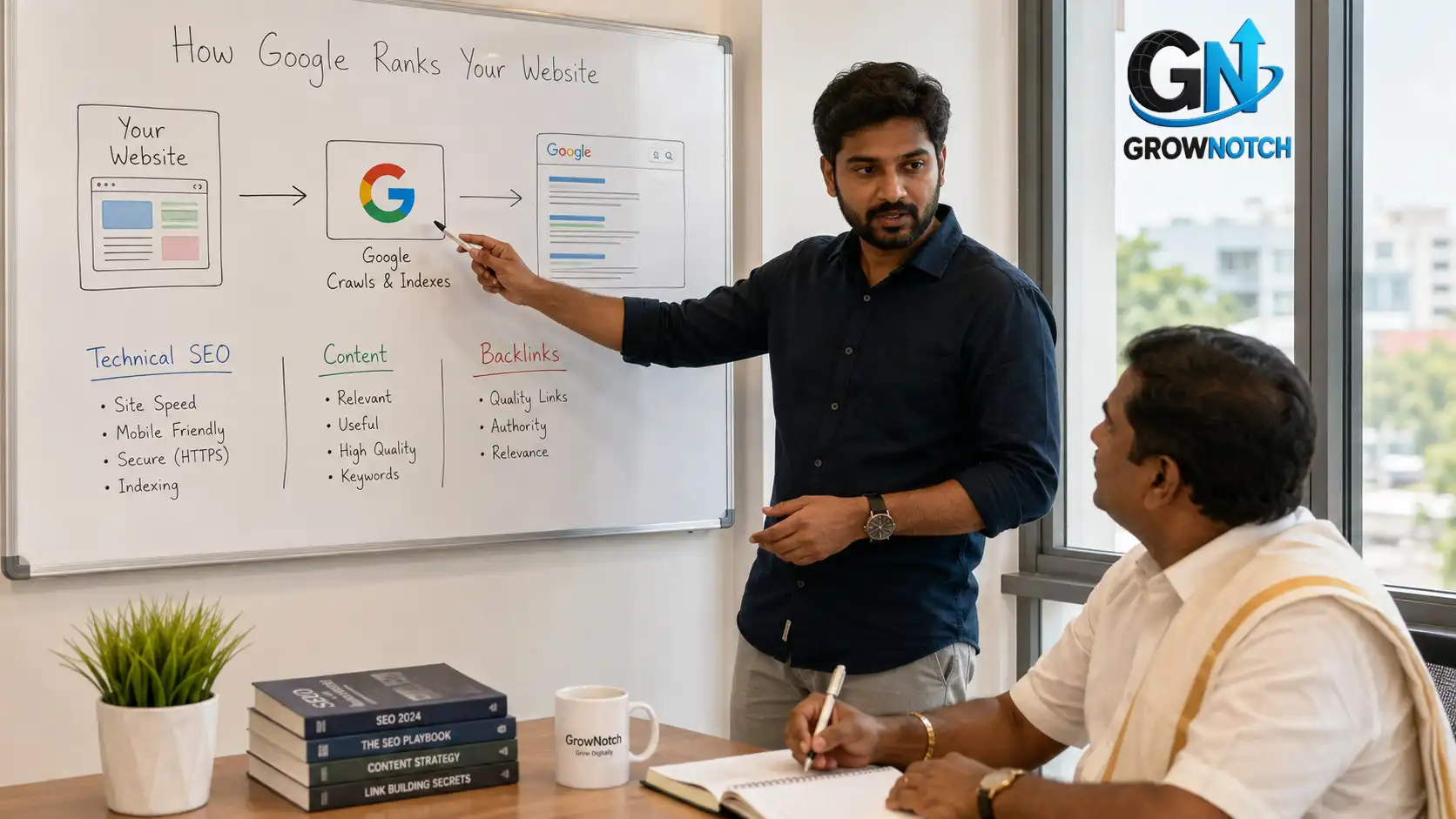
What Is SEO and How Does It Work in 2026?
⚡ QUICK ANSWER SEO (Search Engine Optimisation) is the process of making your website show up higher on Google and other search engines when customers search for your product or service. In 2026, SEO combines technical website fixes, quality content, backlinks, and AI-optimised structure to help businesses rank — and get cited in AI-generated answers from tools like Google's AI Overview and ChatGPT.
Here's a question we hear from business owners across Tamil Nadu almost every week: "I keep hearing I need SEO — but what exactly is it?" The term gets thrown around so much that it's lost all meaning for most people. And that's a problem, because businesses that don't understand SEO can't make smart decisions about it.
This guide breaks it down without the jargon. Whether you run a textile shop in Coimbatore, a logistics company in Salem, or a service business in Chennai — by the end of this post, you'll know exactly what SEO is, how it works in 2026, and what it means for your business practically.
What Is SEO, Really? (The Definition That Actually Makes Sense)
SEO stands for Search Engine Optimisation. At its core, it's the practice of making your website easy for search engines like Google to find, understand, and recommend to users who are looking for what you offer.
Think of Google as a librarian managing billions of web pages. When someone searches for "SEO freelancer in Chennai" or "best garment supplier in Tiruppur," Google's job is to pull the most relevant, trustworthy, and useful result. SEO is the work you do to make sure your website is that result.
It's not about tricking Google. It hasn't been for a long time. The businesses that win at SEO in 2026 are the ones that genuinely help their customers — and structure their website so Google can see that clearly.
How Does SEO Work in 2026? The Three Pillars You Need to Know
SEO has evolved significantly. In 2026, Google uses a combination of traditional ranking signals and AI-powered systems to decide who appears on page one. Here's how it breaks down:
1. Technical SEO — The Foundation
This is the invisible work that makes your website function well for both Google and users. Without it, even great content won't rank.
- Site speed: Google's Core Web Vitals measure how fast your pages load. Slow sites lose rankings — and customers.
- Mobile usability: Over 70% of searches in India happen on mobile. If your site isn't mobile-friendly, you're invisible to most of your audience.
- Crawlability: Google's bots need to be able to read and index your pages. Broken links, incorrect robots.txt files, or poor site structure can block this entirely.
- HTTPS security: Sites without SSL certificates are flagged as unsafe and rank lower.
2. On-Page SEO — Content Google Can Read and Rank (how Google indexes and ranks pages)
On-page SEO is everything within your own website that signals relevance to Google.
- Keyword strategy: Targeting the exact phrases your customers type into Google — like "seo services in chennai" or "digital marketing for small business Tamil Nadu"
- Title tags and meta descriptions: The text Google shows in search results. These must include your target keyword and a compelling reason to click.
- Content quality: Google's E-E-A-T framework (Experience, Expertise, Authoritativeness, Trustworthiness) means content must demonstrate real knowledge — not recycled information.
- Internal linking: Connecting related pages on your site helps Google understand your content structure and keeps visitors exploring longer.
- Schema markup: Structured data that helps Google display your content in rich results — including FAQ boxes, star ratings, and AI Overviews.
3. Off-Page SEO — Building Trust Outside Your Website
Google doesn't just look at your website — it looks at how the rest of the internet talks about you.
- Backlinks: When credible websites link to your content, it signals to Google that you're trustworthy. One quality link from a respected Indian business publication is worth more than fifty low-quality directory submissions.
- Google Business Profile: For local businesses in Chennai, Salem, or Coimbatore, a well-optimised GBP listing is one of the fastest ways to appear in local search results and Google Maps.
- Brand mentions and reviews: Online reviews, social signals, and brand citations contribute to your site's authority even without direct links.
📌 GEO Note (2026): Google's AI Overview and tools like Perplexity and ChatGPT now pull answers from well-structured, credible content. Schema markup and tight paragraph structure are no longer optional — they're what gets you cited in AI-generated answers.
Why Does SEO Matter for Small Businesses in Tamil Nadu?
Let's be honest — most small business owners in India get their first customers through referrals, WhatsApp, and word of mouth. That works at the beginning. But it has a ceiling.
SEO removes that ceiling. When your website ranks on page one of Google for the right search terms, you get enquiries from people who are actively looking for exactly what you sell — 24 hours a day, without paying for every click.
Real-World Context: What Tamil Nadu Businesses Search For
In our experience working with clients across the state, here's what we see consistently: people in Coimbatore search for vendors, consultants, and service providers on Google before making calls. The same is true in Salem, Madurai, and Chennai. If your competitor's website ranks and yours doesn't, you're not even in the conversation.
A textile business in Tiruppur that ranks for "bulk cotton fabric supplier Tamil Nadu" gets enquiries from buyers in Mumbai, Bangalore, and even internationally — buyers who would never have found them through a trade fair alone.
What Has Changed in SEO in 2026 — and Why It Matters
SEO in 2026 is not the same as SEO in 2020. Here are the shifts that matter most for Indian businesses right now:
- AI Overviews dominate page one: Google now shows AI-generated summaries at the top of search results for many queries. Ranking inside these summaries requires structured, well-cited content — not just keyword optimisation.
- E-E-A-T is non-negotiable: Google's quality framework now requires content that demonstrates real first-hand experience, not just aggregated information. Content written by actual experts, citing real data, ranks higher.
- Voice and conversational search is growing: More searches are now question-based — "which is the best SEO consultant in Chennai" rather than "SEO consultant Chennai." Content must address full questions to capture these.
- Local SEO is more competitive: Google Business Profile optimisation, local reviews, and location-specific landing pages are now essential for any business targeting customers in a specific city or district.
- Page experience matters as much as content: Core Web Vitals — loading speed, visual stability, and interactivity — are direct ranking factors in 2026.
Real Example: How SEO Worked for a Salem Service Business
Mini Case Study — IT Training Institute in Salem
A computer training institute in Salem had a functional website but was getting almost no organic traffic. All their enquiries came from Facebook ads — which worked, but cost them ₹18,000–₹22,000 per month with no compounding benefit.
After a structured SEO engagement targeting terms like "computer training institute in Salem" and "tally course Salem," combined with Google Business Profile optimisation and local landing page creation, organic enquiries started arriving within 10 weeks. By month five, they were getting 35–40 organic leads per month at zero additional cost per lead.
The SEO investment paid for itself by month three. The Facebook ads budget was cut in half. That's the compounding nature of SEO that paid ads can't replicate — once you rank, the traffic keeps coming.
How Do You Get Started With SEO for Your Business?
You don't need to understand every technical detail to benefit from SEO. But you do need to get the foundation right. Here's where to start:
- Audit your current website: Identify speed issues, missing meta tags, broken links, and indexing problems. Tools like Google Search Console (free) give you a starting picture.
- Identify the right keywords: Not the most searched — the most relevant to your specific product, city, and customer intent. A bakery in Chennai doesn't need to rank for "bakery" — they need to rank for "custom birthday cakes Chennai" or "eggless cake order online Chennai."
- Fix your Google Business Profile: If you serve local customers, this is the fastest SEO win available. Add photos, update your hours, respond to reviews, and post regularly.
- Create content that answers real questions: Every question your customers ask before buying is a blog topic. Write clear, honest answers and your content starts ranking for those searches.
- Build local authority: Get listed in relevant Indian business directories, get featured in local publications, and earn backlinks from your industry associations or chamber of commerce.
If you want expert help with this, GrowNotch provides dedicated SEO services for businesses across Tamil Nadu — including city-specific strategies for SEO in Coimbatore, SEO in Salem, and SEO in Bangalore.
Key Takeaways: What Is SEO and How Does It Work in 2026?
- SEO is the process of making your website rank higher on Google for searches your customers are already making
- In 2026, SEO covers three pillars: Technical SEO, On-Page SEO, and Off-Page SEO — all three matter
- Google now uses AI Overviews, so content must be structured for both traditional rankings and AI citation
- E-E-A-T (Experience, Expertise, Authoritativeness, Trustworthiness) is how Google judges content quality today
- Local SEO — Google Business Profile, city-specific landing pages, local backlinks — is essential for Tamil Nadu businesses
- SEO takes 3–6 months to build momentum, but unlike paid ads, the results compound over time
Ready to Make SEO Work for Your Business?
SEO isn't magic and it isn't instant. But for a business in Chennai, Coimbatore, Salem, or anywhere in Tamil Nadu that wants a consistent pipeline of customers from Google — it's the highest-ROI long-term investment you can make in your online presence.
At GrowNotch, we work with Indian SMBs who are done waiting for referrals and ready to build something that works around the clock. If you want a no-obligation SEO audit of your website, or just want to understand where you stand right now — we're happy to help.
Reach out at grownotch.com — or explore our city-specific pages for SEO freelancer in Coimbatore, SEO freelancer in Salem, and SEO freelancer in Bangalore.
What's the one thing about SEO you've always wanted to understand better? Drop it in the comments — we'll answer every question.
Frequently Asked Questions
What is SEO in simple terms?
SEO (Search Engine Optimisation) is the process of improving your website, so it appears higher on Google when people search for what you offer. It involves optimising your content, site structure, and online reputation so search engines trust and recommend your site over competitors. Think of it as making your business easy for both Google and real customers to find.
How does SEO work in 2026?
In 2026, SEO works through technical website optimisation, high-quality content, authoritative backlinks, and AI-driven signals like E-E-A-T (Experience, Expertise, Authoritativeness, Trustworthiness). Google now uses AI Overviews to surface direct answers, so good SEO must target both traditional search rankings and AI-generated answer boxes simultaneously.
How long does SEO take to show results?
SEO typically takes 3 to 6 months to show meaningful results for new or low-authority websites. Established websites with good technical health can see improvements in 4 to 8 weeks after targeted fixes. Local SEO in cities like Chennai, Salem, or Coimbatore often shows results faster than competitive national campaigns.
Is SEO still relevant in 2026 with AI search taking over?
Yes — SEO is more important than ever in 2026. AI search tools like Google's AI Overview, Perplexity, and ChatGPT pull their answers from well-optimised, credible web content. A strong SEO strategy ensures your business gets cited in AI-generated answers, not just traditional search rankings.
What is the difference between on-page SEO and off-page SEO?
On-page SEO covers everything on your own website — content, keyword placement, meta tags, site speed, and internal links. Off-page SEO covers external signals like backlinks, Google Business Profile reviews, and brand mentions across the web. Both are essential for ranking well in 2026, and neither works well in isolation.
More from our Blog
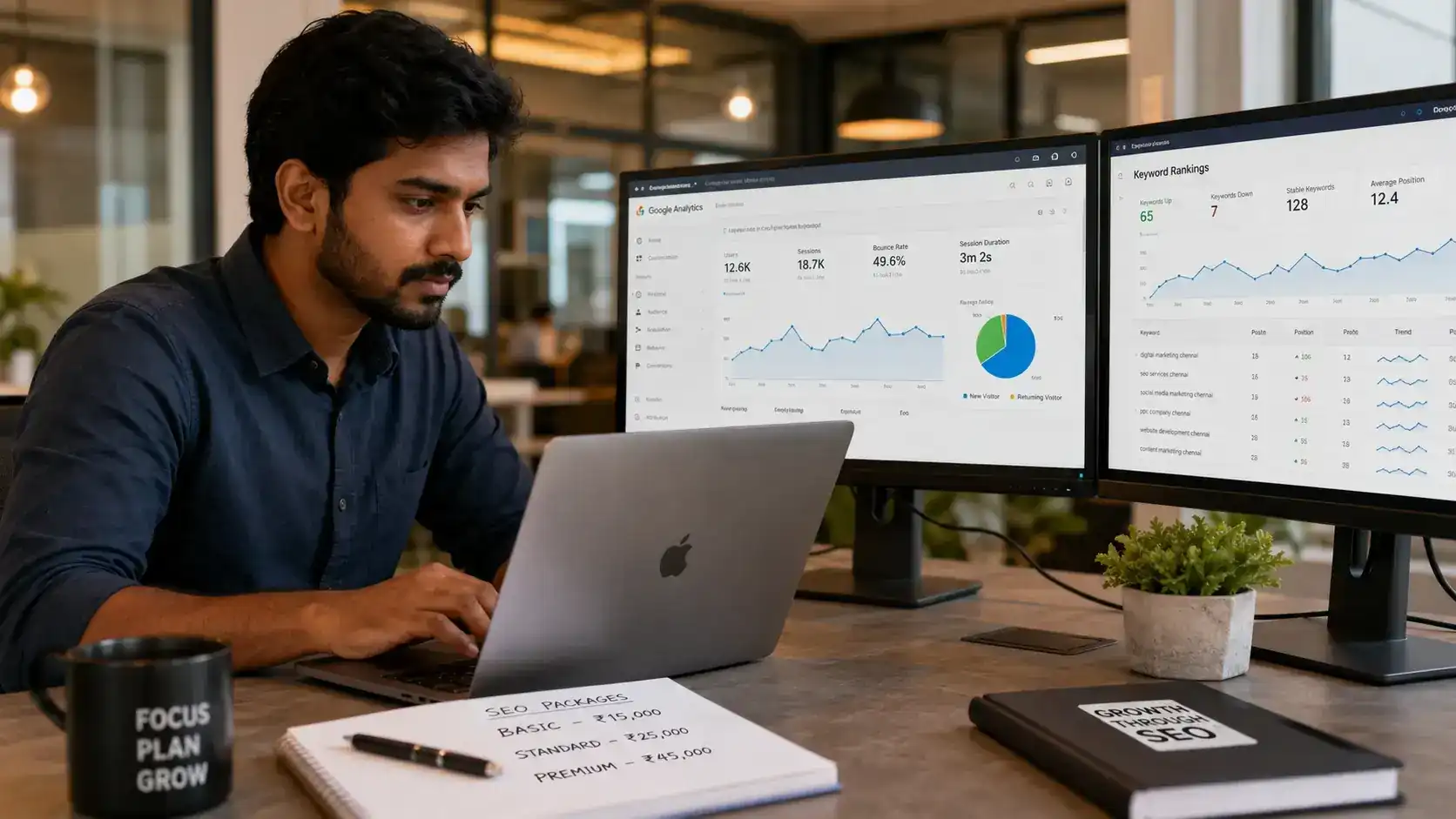
SEO Freelancer in Chennai: What Does It Actually Cost in 2026?
Hiring an SEO freelancer in Chennai but not sure what's a fair price? Costs vary wildly — and knowing the difference can save you from overpaying or hiring someone who won't deliver results. Here's a clear, no-fluff breakdown for 2026.
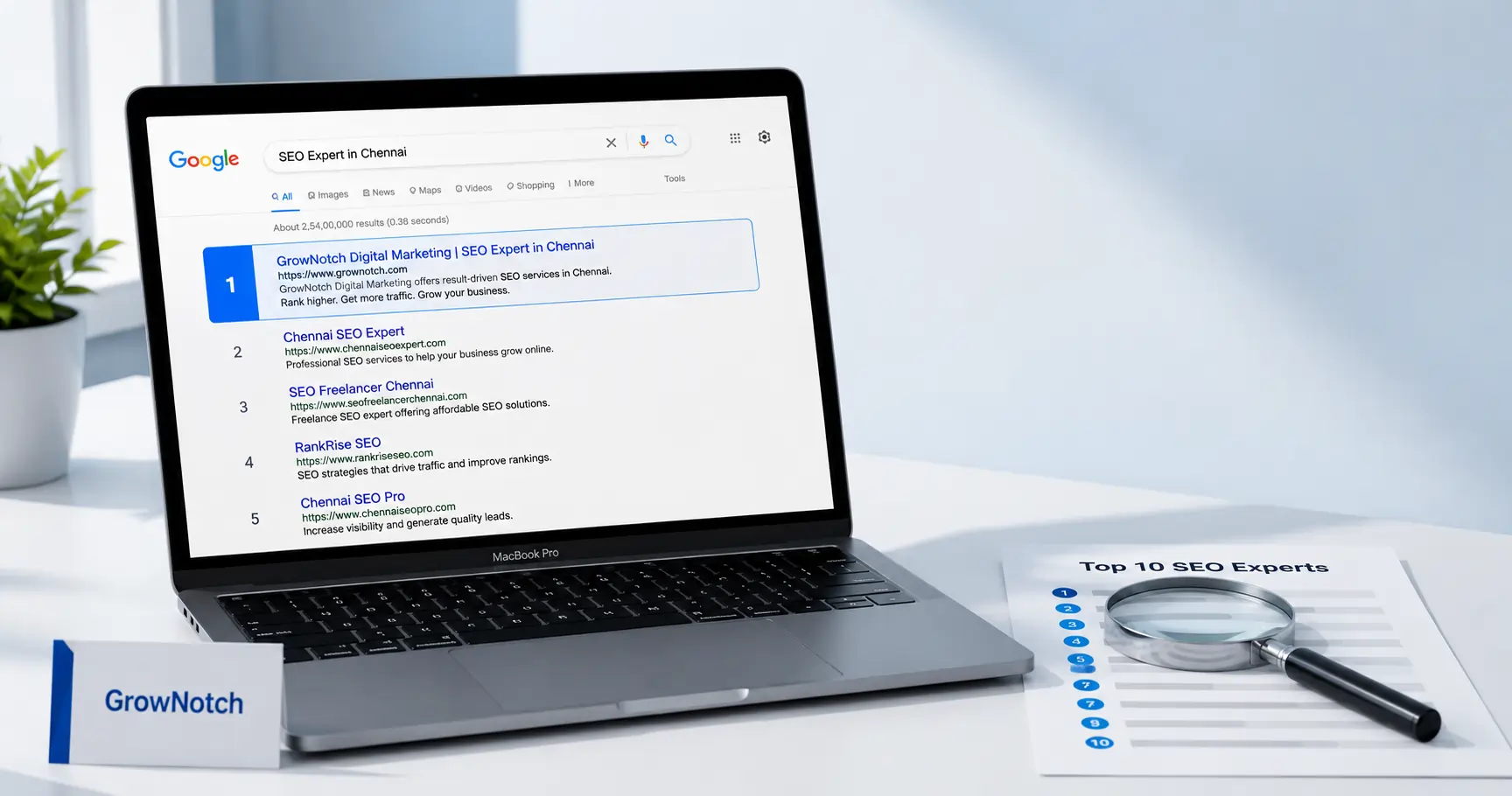
Top 10 SEO Freelancers in Chennai You Should Know in 2026
Finding the right SEO expert in Chennai is harder than it looks. This post breaks down the top 10 SEO freelancers and agencies in Chennai — real names, real specialities — so you can make the right call before spending a rupee.